From ancient stone carvings to the fonts on your smartphone, typography has been silently shaping how humanity communicates, thinks, and connects for thousands of years.
Every word you’re reading right now exists because of typography—the art and technique of arranging type to make written language legible, readable, and visually appealing. We encounter typography thousands of times daily, yet rarely pause to consider its remarkable journey through human history.
The story of typography is nothing less than the story of human communication itself. It’s a tale of ingenious inventors, artistic visionaries, technological revolutions, and cultural transformations. From monks painstakingly copying manuscripts by candlelight to designers crafting pixel-perfect digital fonts, typography has continuously evolved while remaining fundamental to how we share ideas.
In this comprehensive exploration, we’ll travel through the fascinating history of typography—discovering how letters developed, how printing transformed society, and how digital technology revolutionized everything once again. Understanding this history enriches our appreciation of the typography surrounding us and informs better design decisions today.
Before Typography: The Origins of Written Communication
Typography as we know it couldn’t exist without written language. To understand typography’s history, we must briefly acknowledge the writing systems that preceded it.
Human beings communicated through pictures long before alphabets existed. Cave paintings dating back 40,000 years represent our earliest attempts at visual communication. These evolved into pictographic writing systems—symbols representing objects or concepts directly.
Around 3400 BCE, the Sumerians in Mesopotamia developed cuneiform, one of humanity’s first writing systems. Using wedge-shaped marks pressed into clay tablets, they recorded everything from commercial transactions to epic poetry. Meanwhile, ancient Egyptians created hieroglyphics—a complex system combining logographic and alphabetic elements.
The Phoenicians, around 1050 BCE, developed something revolutionary: a purely phonetic alphabet. Their system used symbols representing sounds rather than objects or ideas. This efficient approach required learning only about two dozen symbols rather than thousands. The Phoenician alphabet spread throughout the Mediterranean, eventually evolving into Greek and then Latin alphabets—the direct ancestors of the letters you’re reading now.
The Romans refined the Latin alphabet and established letterforms that remain recognizable today. Roman inscriptions, particularly the famous letters carved into Trajan’s Column around 113 CE, display elegant proportions and serifs that still influence type design two millennia later. These carved letters established the uppercase forms we now call “capitals” or “majuscules.”
Lowercase letters developed later, emerging from the practical needs of medieval scribes writing quickly with quills. These “minuscule” letterforms evolved through various regional scripts before becoming standardized.
The Medieval Period: Manuscripts and the Written Word
Before printing, every book was a manuscript—literally “written by hand.” This reality shaped medieval typography profoundly.
Monastic scriptoriums became centers of book production across Europe. Monks devoted their lives to copying texts, developing increasingly refined calligraphic styles. The most famous of these, Blackletter (also called Gothic script), emerged in the 12th century and dominated European writing for centuries.
Blackletter’s dense, angular forms maximized the number of words fitting on expensive parchment. Its dramatic vertical strokes and intricate details reflected the Gothic architecture and artistic sensibilities of medieval Europe. Different regional variations developed—Textura in Northern Europe, Rotunda in Italy, Fraktur in Germany—each with distinctive characteristics.
Meanwhile, in Renaissance Italy, scholars rediscovered classical Roman texts and developed admiration for ancient letterforms. Humanist scholars created a new script based on Carolingian minuscules from earlier centuries, which they mistakenly believed were Roman. This “Humanist minuscule” featured rounder, more open letterforms than Blackletter—easier to read and write quickly.
These two traditions—Gothic Blackletter and Humanist scripts—would profoundly influence the first printed typefaces and create a typographic divide persisting for centuries.
Gutenberg and the Printing Revolution
No figure looms larger in typography’s history than Johannes Gutenberg. His invention of movable type printing around 1440 in Mainz, Germany, transformed human civilization as profoundly as the internet would five centuries later.
Gutenberg didn’t invent printing itself—the Chinese had developed woodblock printing centuries earlier, and movable type existed in Korea. His innovation combined multiple technologies into a practical, scalable system: individual metal type pieces that could be arranged, locked together, inked, and pressed onto paper, then disassembled and reused indefinitely.
Creating this system required solving numerous technical challenges. Gutenberg developed a special metal alloy for type that was durable yet castable. He invented a hand mold for producing consistent letter pieces quickly. He adapted existing press technology and formulated oil-based inks suitable for metal type.
The Gutenberg Bible, completed around 1455, demonstrated the technology’s potential magnificently. Gutenberg designed his typeface to mimic the Blackletter manuscripts familiar to readers, complete with ligatures and abbreviations scribes commonly used. The result was so convincing that early printed books were sometimes mistaken for manuscripts.
Printing spread across Europe with remarkable speed. By 1500—just fifty years after Gutenberg’s Bible—an estimated twenty million books had been printed. This “print revolution” democratized knowledge, accelerated the Protestant Reformation, fueled the Scientific Revolution, and fundamentally altered how societies functioned.
The Renaissance of Roman Type
As printing spread from Germany to Italy, typographic aesthetics began shifting. Italian printers, influenced by Humanist scholarship and Renaissance artistic ideals, developed typefaces based on Roman inscriptions and Humanist handwriting rather than Gothic scripts.
Nicolas Jenson, a Frenchman working in Venice, created one of the first and finest Roman typefaces around 1470. His letters featured the elegant proportions and balanced serifs that would define the Roman type category. Jenson’s work established Venice as early typography’s creative center.
The great Italian printer Aldus Manutius made several transformative contributions. He commissioned Francesco Griffo to cut new typefaces, including the first italic type in 1501. Originally designed as a space-saving alternative for pocket-sized books, italic soon became a complementary style used for emphasis alongside Roman type.
Aldus also pioneered smaller, portable book formats—making reading a personal, private activity rather than a communal one. His innovations in book design and typography influenced publishing for centuries.
French printers advanced the art further in the 16th century. Claude Garamond created refined typefaces that became international standards, their elegant proportions and readable forms spreading throughout Europe. Garamond’s influence persists today—digital versions of his designs remain among the most widely used typefaces.
By the late 16th century, Roman type had largely replaced Blackletter across most of Europe—except in Germany, where Blackletter persisted until the 20th century.
The Age of Enlightenment: Rational Typography
The 17th and 18th centuries brought new philosophical approaches to type design. Enlightenment ideals of rationality and systematic thinking influenced typography profoundly.
In 1692, King Louis XIV of France commissioned a new typeface based on scientific principles. A committee spent years designing the “Romain du Roi” (King’s Roman) using mathematical grids and measured proportions. While the resulting typeface wasn’t revolutionary aesthetically, the rational approach to type design was unprecedented.
This systematic thinking culminated in the work of John Baskerville in mid-18th century England. Baskerville obsessed over every aspect of printing—type design, ink formulation, paper quality, and press construction. His typeface featured greater contrast between thick and thin strokes, crisp serifs, and refined proportions. Baskerville’s innovations pointed toward the modern typefaces that would follow.
The transition reached its peak with Giambattista Bodoni in Italy and Firmin Didot in France. Working independently in the late 18th century, both designers pushed contrast to extremes—creating typefaces with hairline thin strokes and dramatic thick ones, flat serifs, and rigidly vertical axes. These “Modern” or “Didone” typefaces represented Enlightenment rationalism applied to letterforms.
Bodoni and Didot’s designs were controversial. Critics argued the extreme contrast reduced readability, making text sparkle distractingly on the page. Supporters admired their elegant geometry and precision. This debate about form versus function would recur throughout typography’s subsequent history.
The Industrial Revolution: Display Type Explodes
The 19th century transformed typography as dramatically as it transformed society. Industrialization created new demands—and new possibilities—for printed communication.
The advertising industry emerged as mass-produced goods needed marketing to mass audiences. Posters, broadsides, and advertisements demanded typography that grabbed attention from a distance. The refined elegance of Bodoni and Baskerville wasn’t designed for such purposes.
Type founders responded with an explosion of new display typefaces. Fat faces exaggerated the contrast of modern typefaces to extreme, attention-grabbing degrees. Slab serifs (also called Egyptians) featured bold, rectangular serifs commanding immediate notice. Sans serif typefaces—letters without any serifs—appeared for the first time, initially considered grotesque oddities but gradually gaining acceptance.
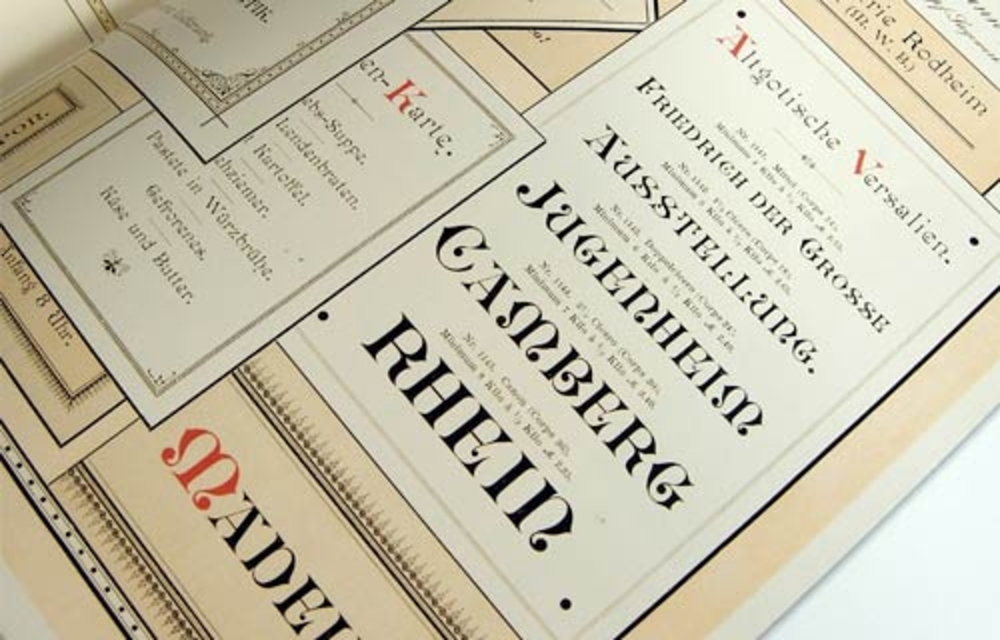
Designers explored every imaginable variation: condensed, extended, inline, outline, shadowed, decorated, three-dimensional. Victorian typography embraced excess enthusiastically, often combining multiple elaborate typefaces in single compositions. While later modernists would criticize this period as chaotic, it demonstrated typography’s expressive potential beyond mere text transmission.
Technological innovations accelerated production. Stereotype and electrotype methods allowed mass reproduction of printing surfaces. The steam-powered press dramatically increased printing speeds. Wood type enabled enormous letters for posters at reasonable cost.
The late 19th century also saw the mechanization of typesetting itself. The Linotype machine, invented by Ottmar Mergenthaler in 1886, allowed operators to set entire lines of type using keyboards rather than assembling individual letters by hand. The Monotype system followed shortly after. These machines transformed the economics of printing, making newspapers and books cheaper and more abundant.
The 20th Century: Modernism and Beyond
The early 20th century witnessed a fundamental rethinking of typography driven by avant-garde art movements and modernist philosophy.
Futurists, Dadaists, and Constructivists challenged every typographic convention. They broke text free from horizontal lines, scattered letters across pages expressively, and rejected traditional hierarchy and readability in favor of visual dynamism. While extreme, these experiments expanded understanding of typography’s potential.
More lasting influence came from the Bauhaus school in Germany and the broader modernist design movement. Designers like Jan Tschichold advocated for “New Typography”—asymmetrical layouts, sans serif typefaces, and functional minimalism. They rejected historical ornament as dishonest and inefficient.
Sans serif typefaces became modernism’s preferred choice. Existing grotesque sans serifs were refined into geometric designs like Futura (1927), whose letters were built from pure circles, triangles, and rectangles. Later, humanist sans serifs like Gill Sans (1926) incorporated subtle calligraphic influences while maintaining modern simplicity.
The mid-century brought the International Typographic Style, developed primarily in Switzerland and therefore often called “Swiss Style.” Designers like Max Miedinger, Josef Müller-Brockmann, and Adrian Frutiger championed objectivity, grid-based layouts, and neutral sans serif typography. Miedinger’s Helvetica (1957) became the movement’s iconic typeface—so neutral and versatile it became nearly invisible through ubiquity.
Not everyone embraced modernist austerity. In the 1960s, psychedelic poster artists and pop culture designers revived decorative, expressive typography. Postmodernist designers in the 1980s and 1990s deliberately broke Swiss Style rules, layering text chaotically, distorting letterforms, and celebrating complexity over clarity.
Throughout these stylistic battles, new typefaces appeared continuously. The 20th century produced countless classics still in heavy use: Times New Roman (1931), designed for newspaper legibility; Palatino (1949), a humanist design by Hermann Zapf; Univers (1957), Adrian Frutiger’s systematically designed sans serif family; and many others.
The Digital Revolution: Typography Transformed
The transition from metal and phototype to digital technology revolutionized typography as profoundly as Gutenberg’s original invention.
Early digital typography in the 1970s and 1980s was crude—limited by low-resolution screens and primitive printers. Bitmap fonts, constructed pixel by pixel, looked jagged at any size other than their specific design dimensions. Typography seemed to be regressing.
Two innovations solved these problems. Adobe’s PostScript language, introduced in 1984, described letterforms as mathematical curves rather than fixed pixels, allowing smooth scaling to any size. And TrueType, developed by Apple and Microsoft in the late 1980s, brought scalable fonts to personal computers.
The Macintosh computer and desktop publishing software like PageMaker democratized typography dramatically. Suddenly, anyone with a computer could access hundreds of typefaces and compose professional-looking documents. This democratization had mixed results—amateur designers made countless typographic mistakes, but it also opened opportunities for creative experimentation.
The web initially seemed hostile to typography. Early browsers supported only a handful of system fonts, limiting design options severely. Designers who wanted specific typefaces had to render text as images—sacrificing accessibility and flexibility.
Web fonts changed everything. Technologies like CSS @font-face support, introduced broadly in the late 2000s, allowed websites to use virtually any typeface. Services like Google Fonts and Adobe Fonts made thousands of typefaces freely or affordably available for web use. Typography on screens finally approached print’s flexibility.
Contemporary Typography: Where We Stand Today
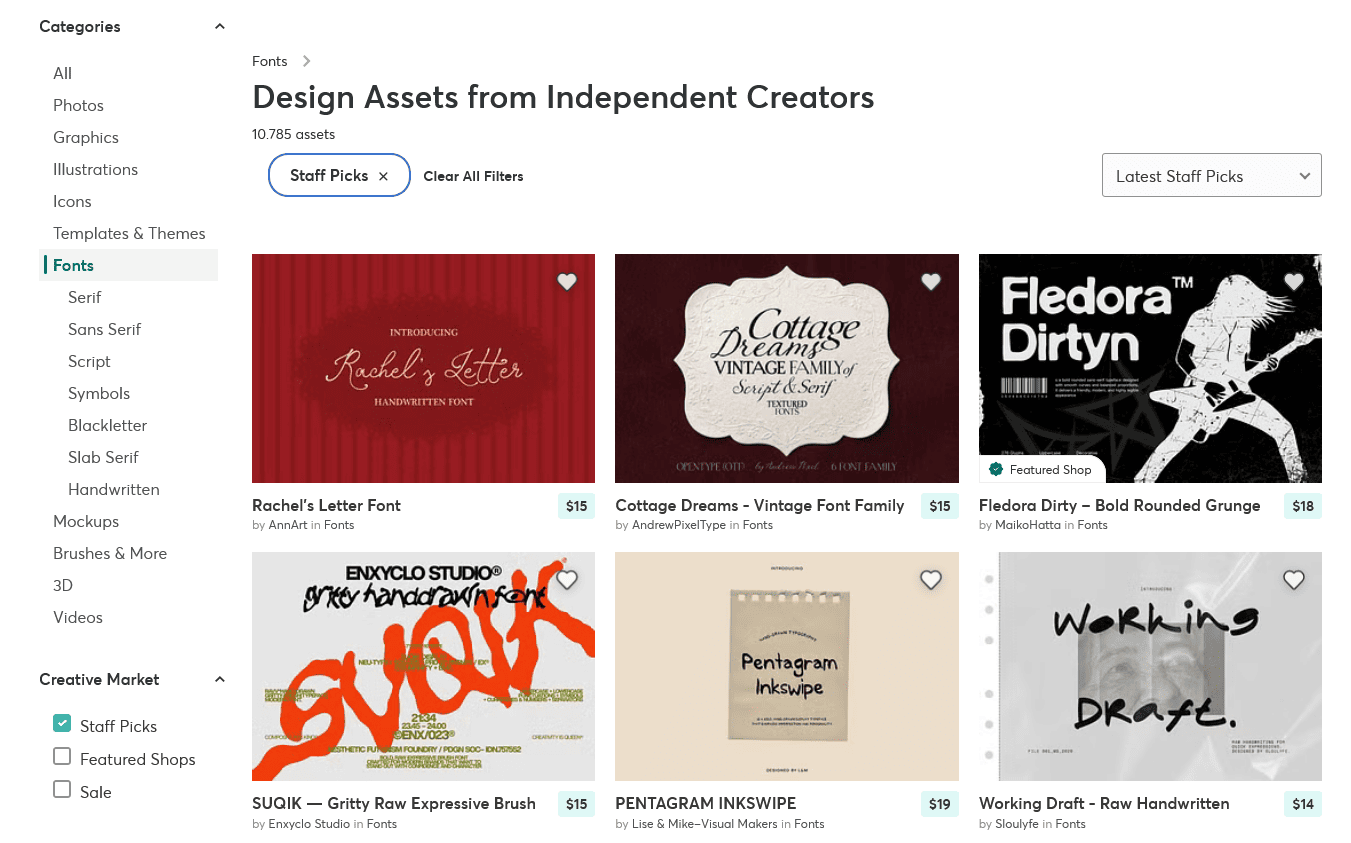
Today’s typographic landscape is unprecedented in its abundance and accessibility. Thousands of high-quality typefaces are available to anyone, many for free. Sophisticated design software runs on ordinary laptops. Variable fonts allow single files to contain infinite weight, width, and stylistic variations.
Contemporary type designers work globally, drawing on diverse cultural traditions while communicating instantly across borders. Independent foundries flourish alongside industry giants. Crowdfunding allows experimental typeface projects to find support directly from users.
Several trends characterize current typography. There’s renewed interest in historical typefaces, with designers creating revivals and interpretations of classic designs. Simultaneously, experimental designers push boundaries with variable fonts, color fonts, and responsive typography that adapts to different screen sizes.
Accessibility concerns have gained prominence. Designers increasingly consider how typography serves readers with visual impairments, dyslexia, and other challenges. Typefaces designed specifically for accessibility, like those improving legibility for dyslexic readers, represent growing awareness of typography’s practical impact.
The rise of non-Latin typography deserves particular attention. For too long, typographic development centered on Latin alphabets used in Western Europe. Today, talented designers are developing sophisticated typefaces for Arabic, Chinese, Devanagari, Thai, and countless other scripts—expanding typography’s global reach.
Typography’s Continuing Evolution
Looking back across typography’s history reveals continuous interplay between technology, aesthetics, and cultural needs. Each era’s typography reflected its tools, values, and communication challenges.
Gutenberg mimicked manuscript traditions because readers expected that appearance. Renaissance printers embraced Roman letterforms reflecting Humanist ideals. Industrial typographers created attention-grabbing display faces for advertising’s demands. Modernists stripped away ornament, seeking universal efficiency. Digital technology democratized typographic access while creating new challenges and possibilities.
What comes next? Artificial intelligence is already generating typefaces and suggesting design choices. Virtual and augmented reality create new environments where typography must function. Global communication demands better support for the world’s writing systems.
Yet certain principles persist across centuries. Readability matters. Context shapes appropriate choices. Typography serves communication first. These fundamentals, established in the earliest printed books, remain relevant regardless of technological change.
Conclusion: Why Typography History Matters
Understanding typography’s history isn’t merely academic exercise—it enriches contemporary practice. Knowing why serifs developed helps designers use them appropriately. Understanding modernism’s principles and limitations enables informed decisions about when to follow or break those rules. Recognizing historical patterns helps predict where typography might head next.
Typography carries centuries of accumulated wisdom in its letterforms. Every font you use today connects to this remarkable heritage—from Roman inscriptions to medieval manuscripts, from Gutenberg’s workshop to Swiss design studios, from early bitmap screens to today’s variable fonts.
The next time you choose a typeface, you’re participating in this ongoing story. You’re making decisions that generations of inventors, artists, and craftspeople made possible. Typography’s history isn’t just background information—it’s the foundation upon which every contemporary typographic choice rests.
From carved stone to glowing pixels, humanity’s journey with letters continues. And typography, as it has for centuries, continues shaping how we share ideas, tell stories, and understand our world.
Typography history in brief: Ancient inscriptions led to medieval manuscripts, Gutenberg revolutionized everything, centuries of refinement followed, and digital technology democratized access while opening new frontiers. The story continues with every font you choose.